
Aging is defined by the body’s diminishing ability to maintain tissue balance, causing a progressive breakdown of functions across vital organs.
Cell therapy offers a compelling regenerative strategy to counteract this decline. This approach administers adult stem cells, sourced from the patient’s own subcutaneous fat, along with specialized effector lymphocytes.
The objective is to replace aged cells and boost the local immune system to improve the tissue environment. This facilitates structural and functional regeneration in vital areas like the brain, heart, and joints, fundamentally improving vitality and offering a powerful pathway toward positive, sustained health in later life.
A TREATMENT PROGRAM TO REVERSE AGEING
To actively combat the structural and functional deterioration of aging, we offer a specialized Cell Therapy Program designed for tissue rejuvenation. This innovative approach recognizes that aging disrupts the essential balance in our tissues—impairing the vital processes of constant remodeling, nutrient supply, toxic waste elimination, and cell replacement. By leveraging the power of cell therapy, our program aims to replenish the tissue’s backup cells, such as stem cells, and optimize the local biological environment. This intervention is designed to restore the tissue’s capacity for self-repair, enhance the function of the immune system, and ultimately work to reverse the biological processes of aging.
When the ageing process affects the vascular tissue, the brain, the heart, the liver, the joints, or the skin, we observe a progressive deterioration in the function of these organs that affects quality of life. It is important to know that not all tissues age in the same way or at the same rate. The tissues most affected are those that:
- require faster cellular turnover, such as the skin or load-bearing joints;
- demand more energy, such as the brain or heart;
- are more exposed to toxic agents, such as those involved in chronic inflammatory processes.
Aging affects organs unevenly; the brain, heart, joints, skin, lungs, and liver are especially vulnerable to decline. Effective management demands a strategic focus on these areas. Through continuous monitoring, we identify early deterioration, which dictates the precise timing for preventive or restorative treatment. Our specialized interventions use advanced cell therapy to address each tissue’s unique needs, aiming to restore cellular balance, enhance resilience, and actively reverse age-related deterioration in a targeted way.
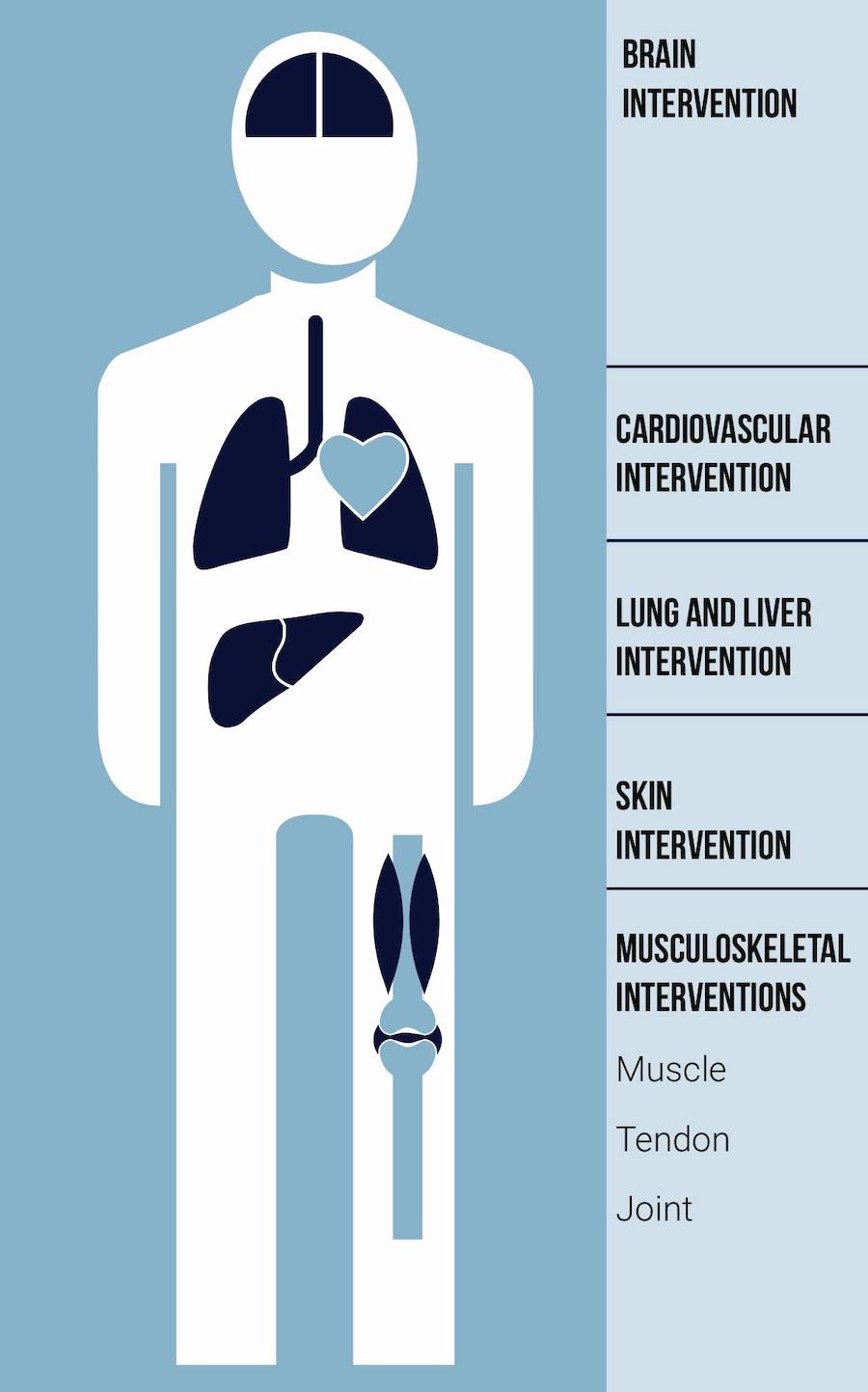
BRAIN
The therapy aims to improve cognitive functions like memory, concentration, and executive functions.
CARDIOVASCULAR SYSTEM
The therapy aims to improve the structure of the arterial wall by increasing its elasticity and resistance, enhance the microvascular network to better distribute oxygen and nutrients to tissues, and improve the structure of the cardiac muscle. Read more.
LUNG & LIVER
The objective is to provide cells that improve the structure and function of the affected organ. Usually, 3–6 infusions are required, with an interval of 6–8 weeks between each one. Read more.
SKIN
The aim is to improve the structural conditions of the skin by increasing thickness, improving elasticity and turgor, and improving microcirculation. Read more.
JOINTS
The aim is to improve the structure of the articular surface by increasing the cartilage surface area and improving the subchondral bone where the cartilage begins to grow and tendons. This enables pain to be controlled and function to be improved. Read more.
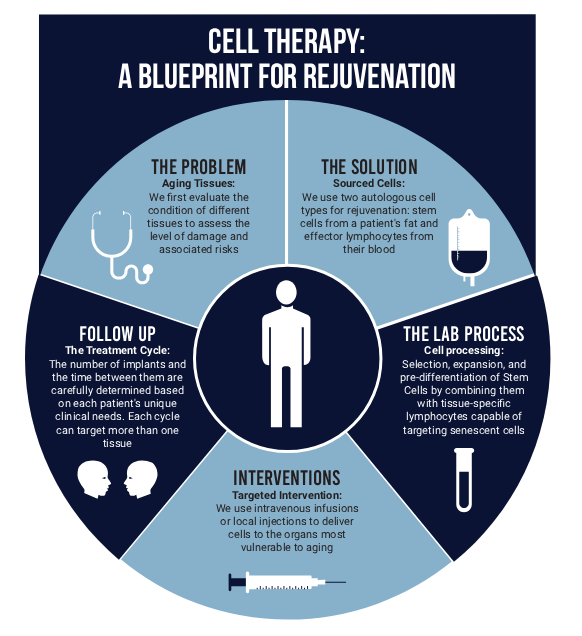
THE TREATMENT CYCLE
TOur regenerative approach is delivered through a highly personalized Treatment Cycle that is guided by two core principles: patient safety and customization. We exclusively utilize your own adult mesenchymal stem cells, which are not genetically modified, thereby eliminating the risk of tumor formation. Throughout the process, we maintain stringent biosafety standards and conduct continuous microbiological controls; any material found to be compromised is immediately discarded. Crucially, each cycle is highly adaptable to clinical needs, often combining intravenous infusions and local applications to effectively address up to four different tissue types.
IF YOU NEED TO MAKE AN APPOINTMENT
OR WANT to request more information
PLEASE, CONTACT US TODAY


Where do the new cells that replace the aged ones come from?
Subcutaneous fat is a tissue with a very slow metabolism that we use very little throughout our lives. This means that the stem cells present in fat have reproduced very few times and therefore have a high potential for expansion. Technology makes it possible to isolate these stem cells from material obtained by liposuction and place them in a culture medium that activates them metabolically, allowing them to multiply significantly and become receptive to differentiation. This means they can become part of a new tissue.
To boost immune tissue, effector lymphocytes are obtained from the patient’s blood. Effector lymphocytes are cells that can recognize specific structures representative of damaged tissue. They participate in the differentiation process of stem cells and facilitate the assimilation of new cells into tissue areas where they are needed.
The method of administration, quantity and frequency of cell application varies depending on the tissue to be treated.
Once the tissue has been chosen, the specific lymphocytes for that tissue are selected and the stem cells are pre-differentiated before they are delivered. Both types of cells (pre differentiated stem cells and lymphocytes) are administrated.